Three Recent Articles (On Landscape and Nature Vision)
Written by Sarah Marino
I have recently written three new, in-depth articles, with two published in On Landscape and one in Nature Vision Magazine. Both of these publications are online magazines and all three articles are behind a paywall. I personally read and value both of these publications, and appreciate the opportunity to share my thoughts about photography in these places. I include a preview of each article below, along with an access link if you subscribe (or want to start a subscription!) to these publications.
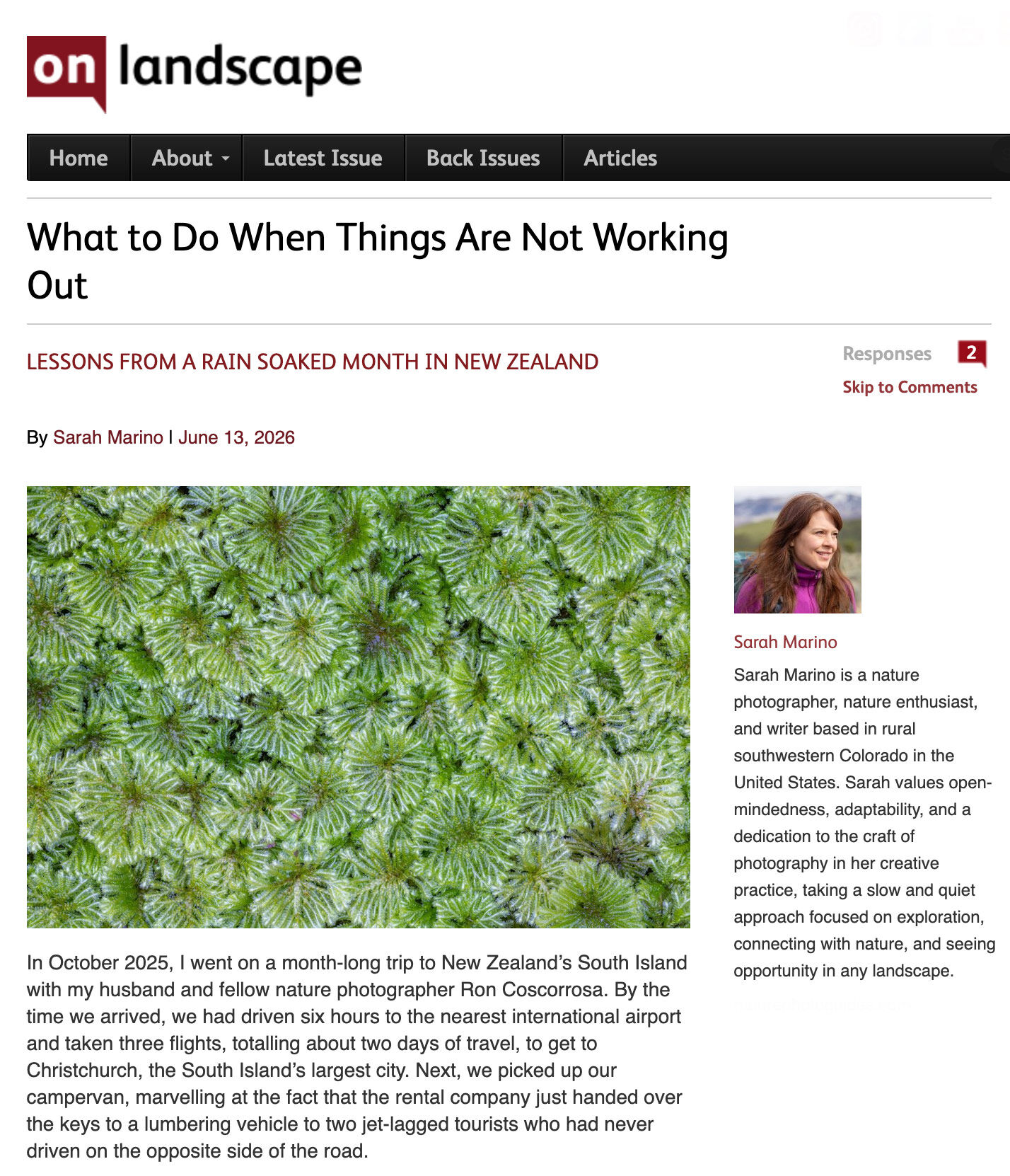
What to Do When Things Are Not Working Out
In October 2025, I went on a month-long trip to New Zealand’s South Island with my husband and fellow nature photographer Ron Coscorrosa. By the time we arrived, we had driven six hours to the nearest international airport and taken three flights, totaling about two days of travel, to get to Christchurch, the South Island’s largest city. Next, we picked up our campervan, marveling at the fact that the rental company just handed over the keys to a lumbering vehicle to two jet-lagged tourists who had never driven on the opposite side of the road.
We originally planned this trip for 2020 to celebrate milestone birthdays for both of us. We instead watched those plans and so many others fizzle away with the worldwide COVID pandemic. In 2025, with the flights, the campervan, and more than a month away from home, this would be, by far, our most expensive trip to date. And while I pride myself on approaching photography with an open mind and minimized expectations, I had high hopes for the trip because of this serious investment of time and money, accompanied by years of anticipation.
As we headed for our first destination along the West Coast, traveling up through the mountainous roads winding through Arthur’s Pass National Park, we remarked about the strength of the wind and heaviness of the rain, assuming it would ease up as we descended back toward the coast. Except for a few brief windows of respite, this wind and rain did not ease up for the next two weeks, and continued in long spurts for the rest of the trip. Slips, or mudslides as we call them in the United States, and downed trees closed down most of the roads leaving the West Coast and left a big portion of the island without power. Heavy rains caused extensive flooding, and as we travelled through the island’s southeastern region, we saw hundreds of non-native trees, previously growing in orderly hedgerows, uprooted and resting on the ground due to the strong winds.
With this kind of widespread damage, it feels petty to assess this situation through the lens of photography but since we were there for photography, we, of course, assessed the situation through the lens of photography. With the wind driving intense waves toward shore, many of the beaches were inaccessible even at lower tides and when some walkable sand appeared, it was covered in thick, jiggling foam. That same wind left the moss-covered forest floors carpeted in debris. And the rain… This was the kind of soaking rain that could ruin even a weather-sealed camera in less than five minutes.
We agreed that this was becoming the trip of a thousand photographic ideas thwarted by ten thousand gusts of unrelenting wind and billions of drops of rain. While seeing the scenery from inside the campervan was enjoyable enough, we were there to be outside experiencing the landscape without a rain-covered window as an intermediary. I’d be lying if I said that I was able to fully rise above the disappointment and expectations because I wasn’t. I regularly experienced these feelings, especially as I set up a composition and waited for what seemed like forever for a lull in the wind that never came on too many occasions.
So, on a very expensive photo trip half-way around the world, what do you when things are not working out?
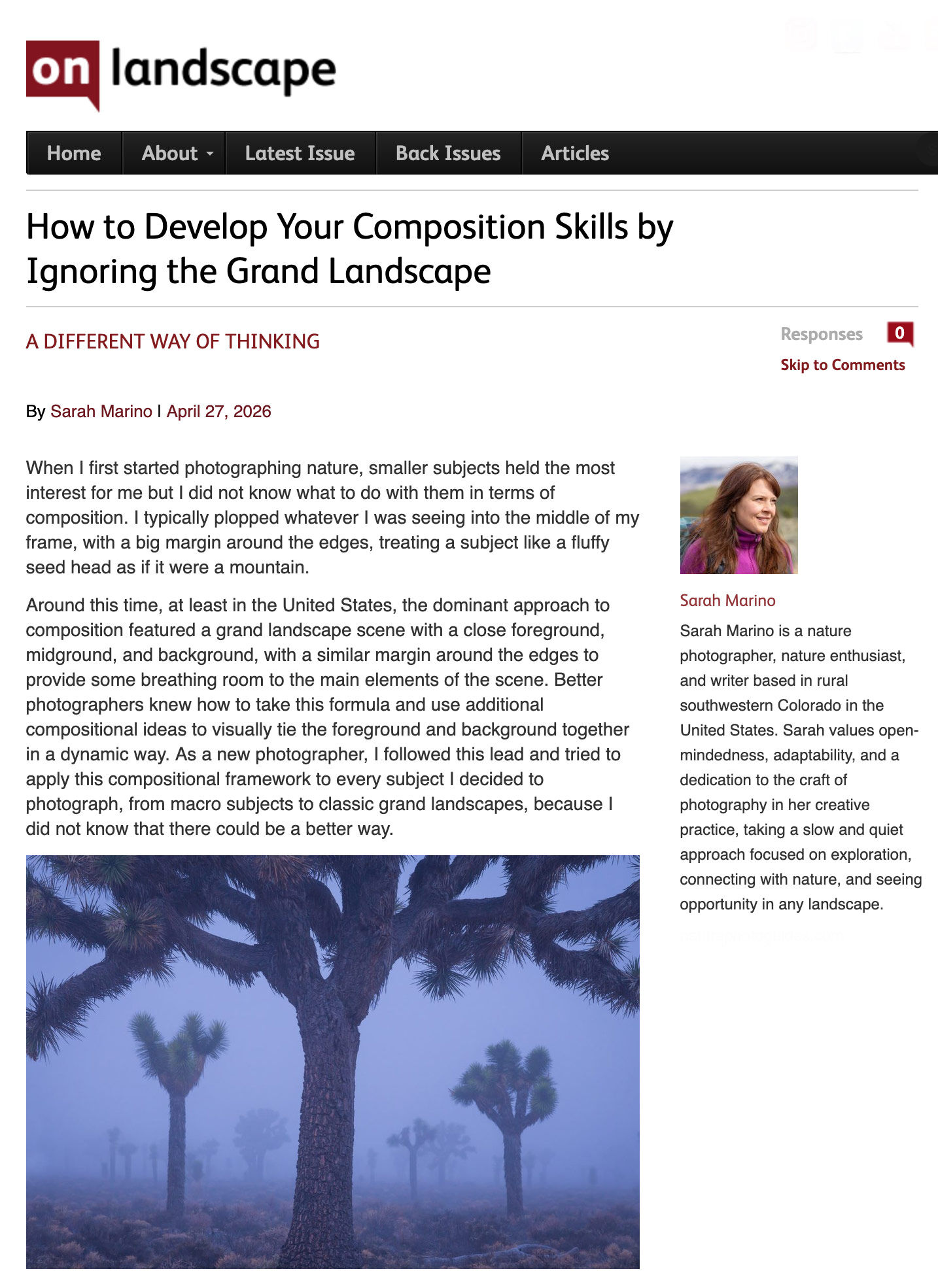
How To Develop Your Composition Skills by Ignoring the Grand Landscape
When I first started photographing nature, smaller subjects held the most interest for me but I did not know what to do with them in terms of composition. I typically plopped whatever I was seeing into the middle of my frame, with a big margin around the edges, treating a subject like a fluffy seed head as if it were a mountain.
Around this time, at least in the United States, the dominant approach to composition featured a grand landscape scene with a close foreground, midground, and background, with a similar margin around the edges to provide some breathing room to the main elements of the scene. Better photographers knew how to take this formula and use additional compositional ideas to visually tie the foreground and background together in a dynamic way. As a new photographer, I followed this lead and tried to apply this compositional framework to every subject I decided to photograph, from macro subjects to classic grand landscapes, because I did not know that there could be a better way.
As my curiosity extended beyond this composition recipe, I realised that what beginning photographers learn as the “rules of composition” aren’t helpful in many situations, especially for photographing smaller scenes and intimate landscapes in nature, and often do not align with my visual preferences as I know them now. After finding photography resources on composition lacking, I turned to the field of graphic design and found a few concise, helpful books to point me in a new direction.
After reading these books, I started to think about composition differently, with a varied library of visual design concepts as the starting point. Instead of recipes and rules, I found a framework: Once we, as photographers, have found a scene we want to turn into a photograph, we can layer and blend these concepts, choosing the best tools based on the subject we are photographing and the visual message we hope to convey. And if our first attempt does not turn out as we might have hoped, we can start over, working with a different set of concepts to guide us in a different direction.
It is now common to hear photographers say that photographing intimate landscapes and smaller scenes is a more expressive way of seeing the world. I disagree with this blanket assessment, as many landscape photographers working today are creating unique grand landscapes that effectively communicate their personal photographic vision through the wider view. However, I do believe that devoting time to working with smaller scenes can deepen your observation skills and, as a result, significantly improve your composition skills, as well. Even if smaller scenes are not a source of creative inspiration for you, learning to photograph them could help build your visual language and improve your ability to convey your vision in a compelling way by expanding your personal library of favorite design concepts and refining how you use them.
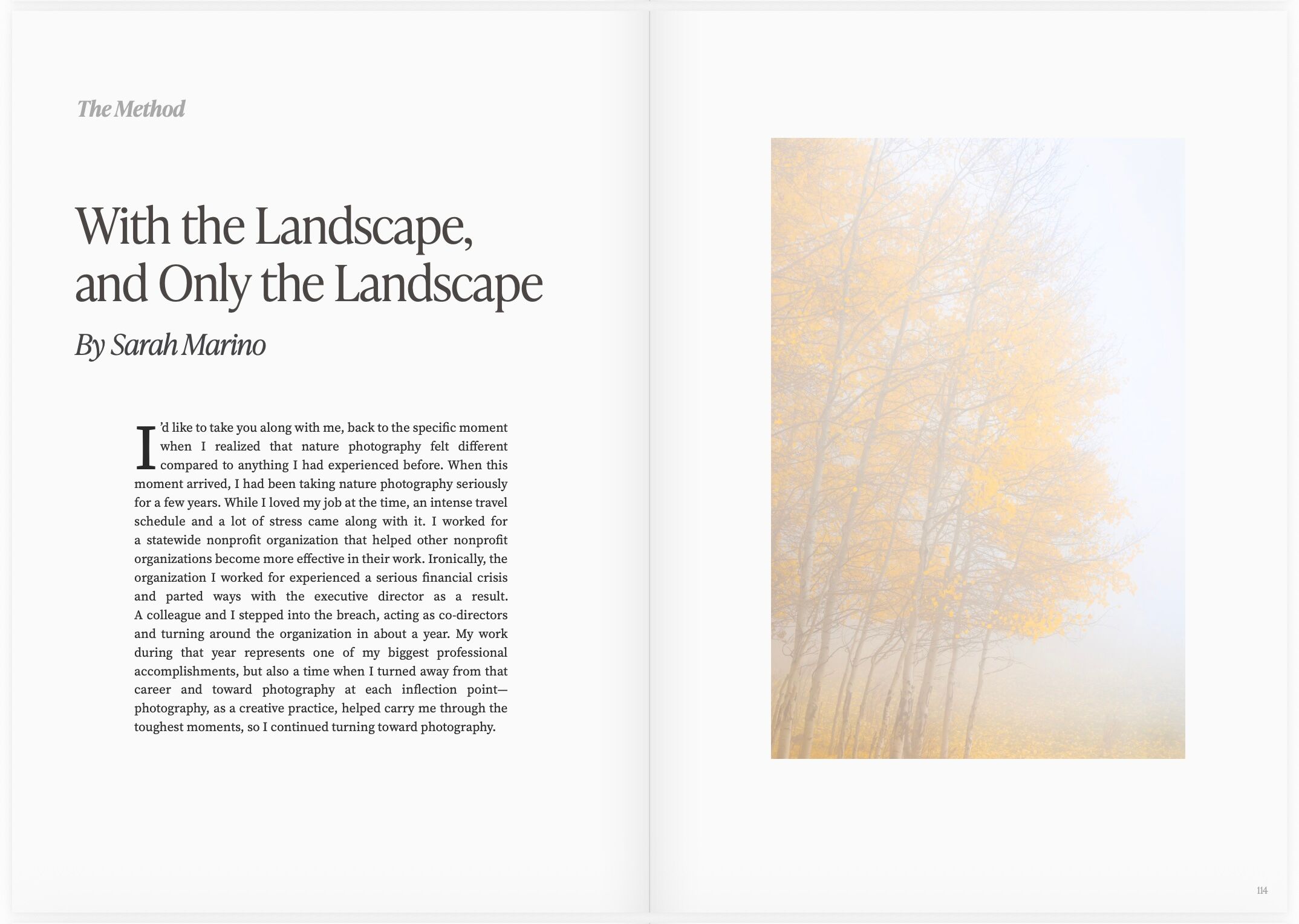
With the Landscape, and Only the Landscape
Iʼd like to take you along with me, back to the specific moment when I realized that nature photography felt different compared to anything I had experienced before. When this moment arrived, I had been taking nature photography seriously for a few years. While I loved my job at the time, an intense travel schedule and a lot of stress came along with it. I worked for a statewide nonprofit organization that helped other nonprofit organizations become more effective in their work. Ironically, the organization I worked for experienced a serious financial crisis and parted ways with the executive director as a result.
A colleague and I stepped into the breach, acting as co-directors and turning around the organization in about a year. My work during that year represents one of my biggest professional accomplishments, but also a time when I turned away from that career and toward photography at each inflection point— photography, as a creative practice, helped carry me through the toughest moments, so I continued turning toward photography.
The job required regular travel to the far reaches of rural Colorado and, before and after work meetings, I found wild and natural places nearby to photograph—places I likely would have never ended up on my own but came to love with time and familiarity. On one frigid morning in February, before a meeting I knew would be challenging, I headed to the Monte Vista National Wildlife Refuge outside of Alamosa, Colorado, to look for photo opportunities around sunrise. Given the cold temperatures, I hoped I might find some ice to use as a foreground for a wide-angle scene, with the snow-capped 14,350-foot-tall Blanca Peak in the distant background.
After a bit of slow searching from the refugeʼs main road, I came upon a shallow wetland filled with a dense thicket of brown grasses and slender sedges. I could see a clear path winding through the grasses to a more open area. As the grasses slowly gave way, steely blue ice filled a broad open area, with sharp, angular fissures extending in zig-zags across the expanse of frozen emptiness. While the lines were rigid and straight when viewed from afar, their delicate edges were frilly and soft, with tiny frozen bubbles filling in the gaps. I had only seen ice like this in other peopleʼs photographs and felt overcome with fascination and excitement as I explored different composition options while softly textured storm clouds shifted through the colors of a subtle sunrise. The morning slipped by so fast, with joyful wonder and intense focus combining into a superlative experience.
Looking at the time jolted me back to reality, as I was going to be late to my meeting. As I hastily packed up my camera, I experienced what felt like a profound moment of insight at the time. This is what being present feels like, when anxieties, thinking about the daily grind, and an infinitely long to-do list just fade fully into the background and are completely silenced by being in the here and now. Out on the ice, I felt as if I was flowing through time with the landscape, and only the landscape. While this was not the first time I had felt glimmers of this experience, it was the first time I felt it strongly enough to stop and notice it. On that day, the specific combination of experiences must have created an opening for a moment of lucidity—the serious stress of work on the low side and the joyful feeling of calm, intense focus in working with the ice on the other. The chasm felt so wide that I had to pay attention to it.